Integrated Protection, Healthcare and Inclusion for Vulnerable Newly Displaced Persons, IDPs and Other Vulnerable Groups in Dnipropetrovsk, Zaporizhzhia and Donetsk Oblasts
01.09.2026
2026
Donor:
Volontariato Internazionale per lo Sviluppo (VIS)
“Support That Stays Close”: LAOI Helps Vulnerable People Overcome Barriers to Essential Services:
For a person with a disability, an older person, or someone with limited mobility, even an ordinary trip to a doctor, completing paperwork, or accessing a social service can become a serious challenge. During wartime—especially in frontline communities and after forced evacuation—these barriers become even more significant.
Addressing these barriers is at the heart of the work carried out by the Luhansk Association of Organizations of Persons with Disabilities (LAOI) within the project “Integrated Protection, Healthcare and Inclusion for Vulnerable Newly Displaced Persons, Internally Displaced Persons and Other Particularly Vulnerable Groups in Dnipropetrovsk, Zaporizhzhia and Donetsk Oblasts.”
The project is implemented with the support of the Ukraine Humanitarian Fund (UHF) in partnership with Volontariato Internazionale per lo Sviluppo (VIS). It runs from 1 May 2026 to 30 April 2027 and is expected to reach 9,809 direct beneficiaries. During the project preparation stage, VIS, STEP IN and LAOI jointly conducted a needs assessment across the three oblasts, collecting 456 questionnaires.
Support Where Barriers Are Greatest
A key feature of the project is that it supports people in different circumstances: those who remain close to the frontline; those who have recently been evacuated and are passing through transit centres; and IDPs and other vulnerable people who are already living in relatively safer communities but continue to face serious barriers to services due to disability, age, prolonged displacement, or other circumstances.
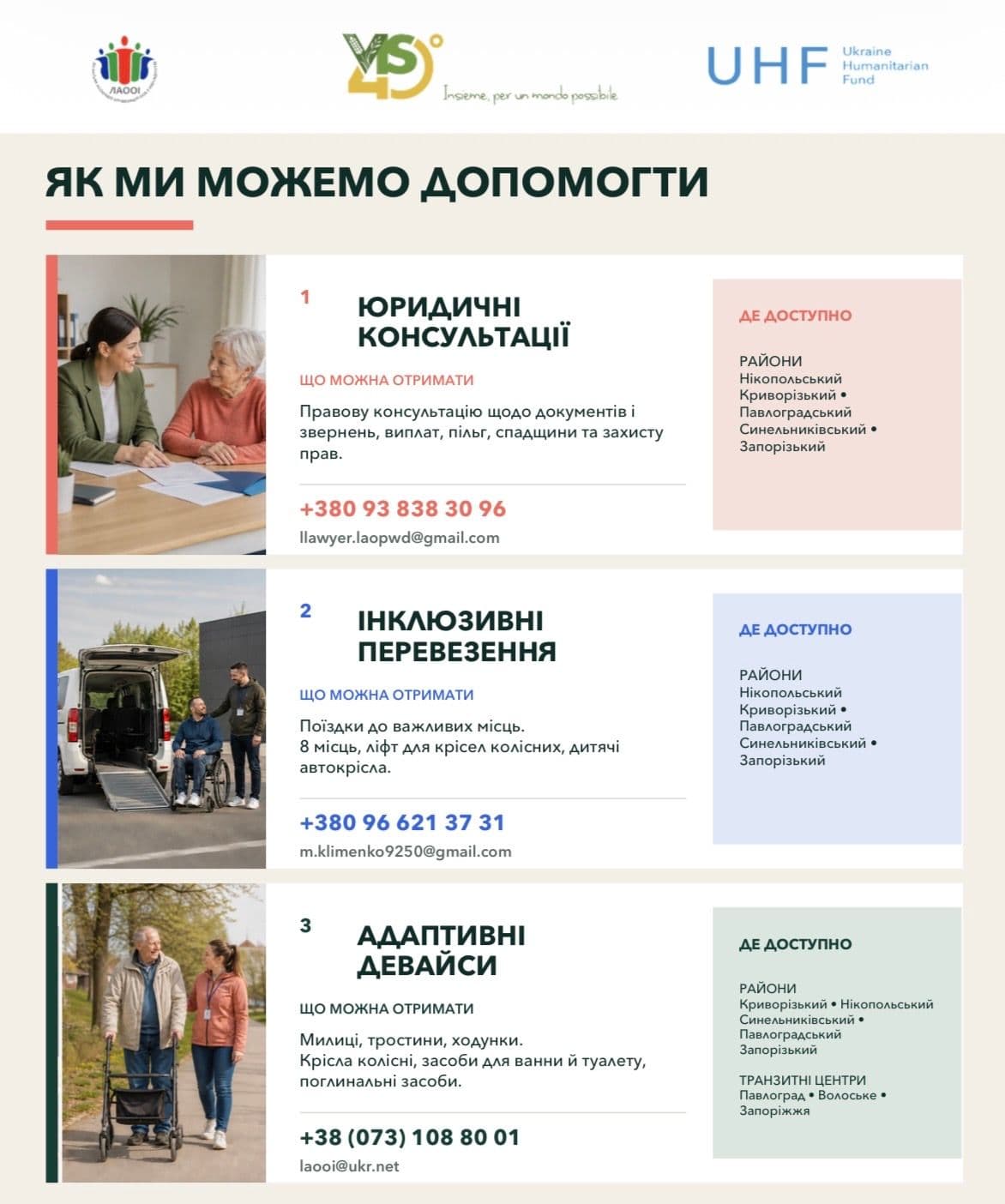
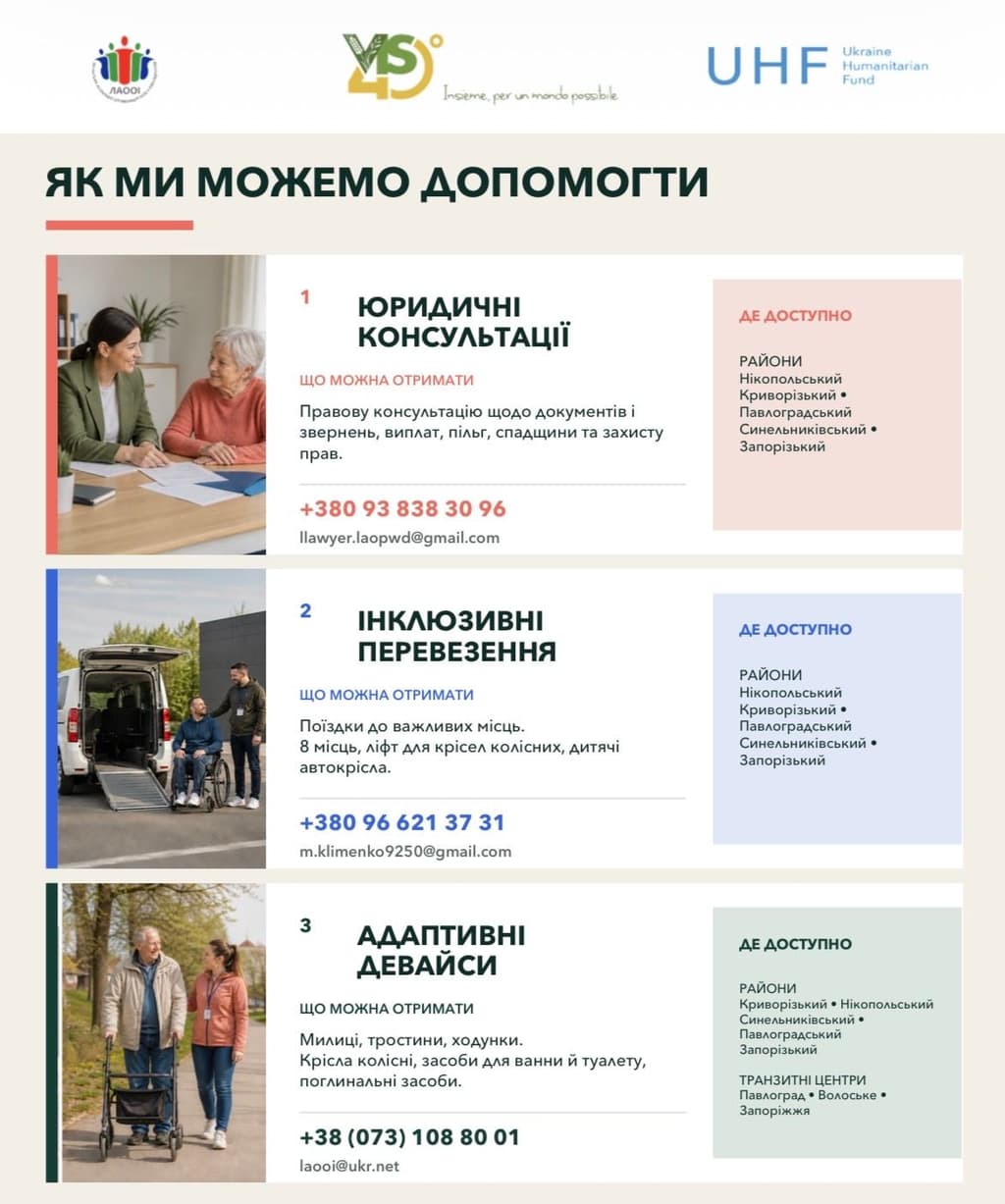
LAOI’s role within this system is to make assistance genuinely accessible to persons with disabilities, people with limited mobility, IDPs, and others in vulnerable situations. The organisation provides legal assistance, inclusive transportation, assistive and adaptive devices, training on inclusion and accessibility, consultations on assistive technologies, as well as accessible feedback and complaints mechanisms.
From Legal Advice to Practical Solutions
Lost documents, access to social benefits and entitlements, inheritance, housing, land and property issues, disability status determination—legal challenges often accumulate for people who have experienced evacuation or forced displacement.
This is why legal assistance is one of LAOI’s major areas of work within the project. Consultations are provided both during joint mobile team visits and remotely, by phone or online.
The project plans to provide legal assistance to 1,200 people: 600 people in frontline areas and another 600 IDPs and other particularly vulnerable people in stabilised communities.
When a Person Cannot Reach a Service, Support Must Reach the Person
The mere presence of a hospital, social service, or administrative institution does not automatically make a service accessible. For a wheelchair user, a person with reduced mobility, or an older person unable to use conventional transport independently, even a few kilometres can become an insurmountable distance.
To address this, LAOI organises inclusive transportation to healthcare facilities, social services, administrative institutions, legal services, and other essential destinations.
The specialised vehicle has eight seats, a wheelchair lift, and child car seats. Overall, the project plans to provide inclusive transportation services to 800 people.
600 People to Receive Essential Assistive Devices
Another important component of the project is providing people with equipment that can significantly improve their independence in everyday life.
This includes wheelchairs, walkers, crutches, canes, bathroom and toilet aids, and absorbent hygiene products. Importantly, these items are provided according to each person’s individual needs. When necessary, STEP IN physiotherapists refer beneficiaries to LAOI’s consultant on assistive technologies and rehabilitation equipment.
Overall, this component is expected to support 600 people: 150 people in frontline and near-frontline communities, 300 people in transit centres and host communities, and another 150 people in stabilised communities.
Accessibility Is About More Than Ramps
Physical accessibility is only one part of inclusion. It is equally important that professionals working with people every day understand their needs and know how to make services genuinely accessible.
For this reason, LAOI will conduct training sessions for representatives of local authorities, social services, healthcare and educational institutions, civil society organisations, and other service providers.
The training will cover accessibility, inclusion and non-discrimination, protection of vulnerable groups, ethical interaction, accessible service provision, and the practical implementation of inclusive solutions.
The project plans to hold six in-person training sessions with a total of 90 participant attendances. In addition, 30 project staff members will receive dedicated training on disability inclusion and accessibility principles.
Where LAOI Services Are Available
Legal consultations and inclusive transportation services are available in the Nikopol, Kryvyi Rih, Pavlohrad and Synelnykove districts of Dnipropetrovsk Oblast, as well as in the Zaporizhzhia district of Zaporizhzhia Oblast.
Assistive and adaptive devices are also provided through transit centres in Pavlohrad, Voloske and Zaporizhzhia.
Support That Stays Close
Behind every project figure is a real-life situation: a person who cannot independently reach a doctor; an IDP family trying to restore documents or access benefits; someone who has just been evacuated and urgently needs a walker or wheelchair; or an older person for whom reaching a social service is practically impossible without accessible transportation.
This is why the core principle of LAOI’s work can be expressed simply: to remove the barriers standing between a person and the support they need. To help them reach essential services, receive professional advice, obtain the right assistive device, resolve documentation issues, and exercise their rights.
This idea is captured in the project’s concise message:
“Support That Stays Close.”
The project “Integrated Protection, Healthcare and Inclusion for Vulnerable Newly Displaced Persons, Internally Displaced Persons and Other Particularly Vulnerable Groups in Dnipropetrovsk, Zaporizhzhia and Donetsk Oblasts” is implemented with the support of the Ukraine Humanitarian Fund (UHF) by the Luhansk Association of Organizations of Persons with Disabilities (LAOI) and Volontariato Internazionale per lo Sviluppo (VIS).
Projects
All projects2026
Integrated Protection, Healthcare and Inclusion for Vulnerable Newly Displaced Persons, IDPs and Other Vulnerable Groups in Dnipropetrovsk, Zaporizhzhia and Donetsk Oblasts
01.09.2026
Read more
2026
Inclusive Accommodation and Protection for Vulnerable Internally Displaced Persons in Kharkiv Oblast
31.08.2026
Read more
2023
“ Network of Inclusion Advisors “ Lviv and Ivano-Frankivsk regions
29.12.2024
Read more